DockSafe runs recurring electrical scan cycles across your entire marina basin. Every reading is GPS-mapped and voltage-measured. We track micro-changes between cycles, flag emerging hazards before they escalate, and give you a defensible, timestamped record that protects your marina and your guests.
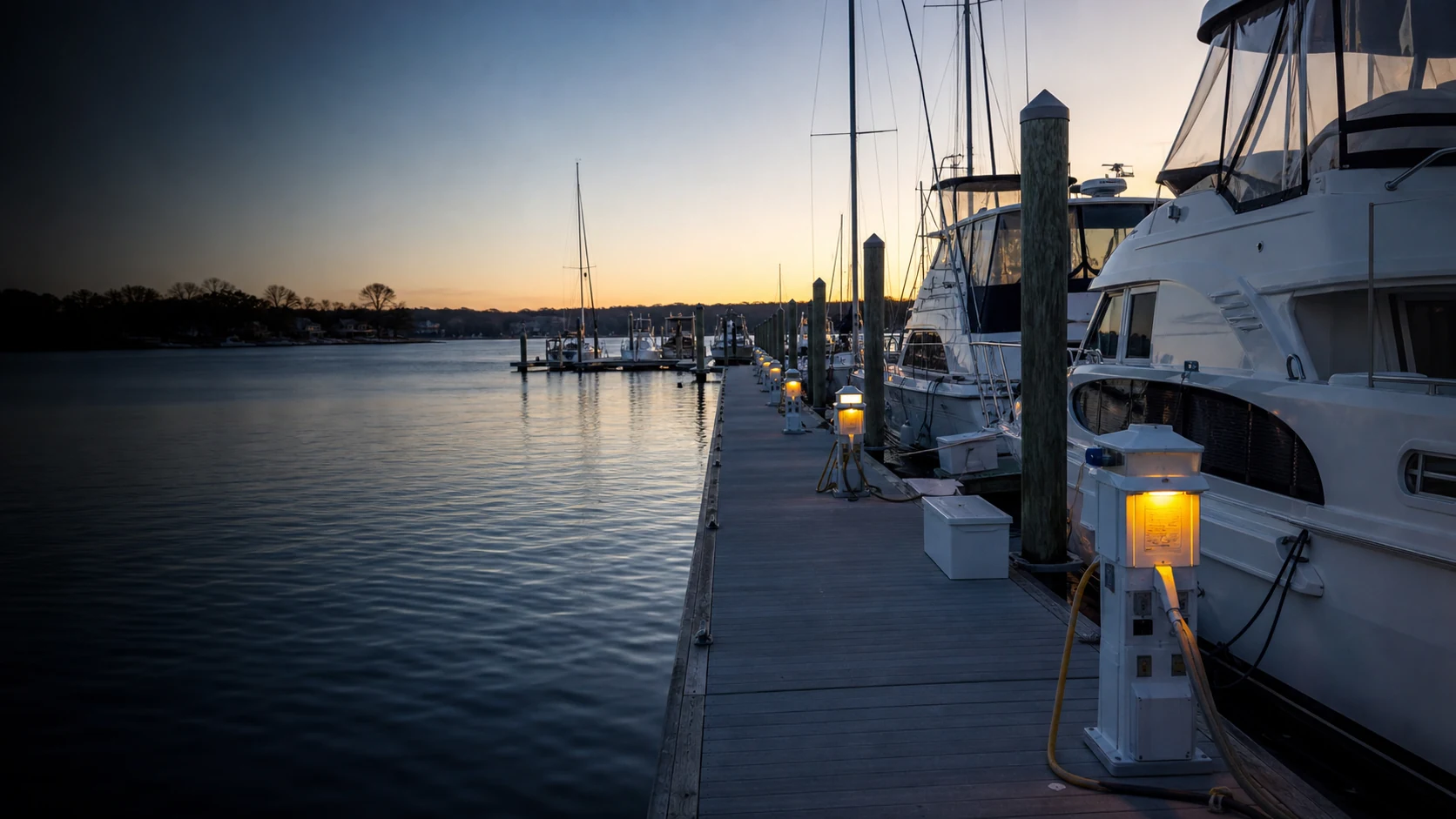
Electric Shock Drowning happens when stray current — AC or DC — enters the water from a nearby source. Common culprits include aging shore power wiring, a damaged pedestal, or a boat with a ground fault. The current is invisible. There are no warning signs. And without active stray voltage monitoring, most marina operators have no way of knowing it's there.
A stray voltage monitoring program is one of the most practical steps a marina operator can take to stay ahead of this risk — and to demonstrate that due diligence if it's ever questioned.
Start a Monitoring ProgramEvery scan follows a fixed route across your entire marina basin — the same slips, the same dock faces, the same waterways, every time. That consistency is what makes change detectable.
Every scan produces a dense dataset of individual GPS-tagged voltage readings across your entire marina basin. Each reading is plotted on a live satellite map in real time, building a rich, high-resolution picture of the water — every slip row, dock face, fairway, and fuel dock covered systematically.
The most dangerous stray voltage issues don't appear overnight — they develop gradually. Our software compares every scan against all prior ones at the same GPS zones, automatically flagging any meaningful voltage shift. That early signal is what makes intervention possible before a hazard becomes a liability.
The basin is divided into fixed geographic zones. Readings within each zone are aggregated and scored, so every area of your marina has a quantified stray voltage profile — not just a raw scatter of data points.
Before any report is delivered, every scan goes through an internal quality check. Coverage across the basin is validated, abnormal readings are reviewed, and any issues are addressed — so you can trust that every report reflects a complete, verified picture of your marina.
Readings that exceed safe thresholds are flagged automatically. Abnormal zones are highlighted on the map and included in the report with exact GPS coordinates — no manual review required to surface a problem area.
Each cycle produces a detailed HTML and PDF report: the full GPS voltage map, flagged zones with exact GPS coordinates, and a change summary vs. all prior cycles — all timestamped and ready to present to insurers, regulators, or legal counsel.
When a zone shows an anomaly or needs a closer look, we can isolate it for a targeted rescan during the same visit — without re-covering areas that already checked out cleanly.
Every scan is stored, indexed by marina and date, and retrievable at any time. If a question arises months later — from an insurer, an attorney, or a slip holder — the record is there: timestamped, GPS-mapped, and unambiguous.
Same route. Same process. Every visit. Here's what a scan cycle looks like start to finish.
Contact us to get started. We'll gather your marina details, map the full basin perimeter using satellite imagery, and build a precise scan route covering every slip row, dock face, and waterway — saved permanently for all future cycles.
On each visit we take to the water and systematically cover the entire basin. A dense set of voltage readings is captured — each one GPS-tagged, timestamped, and plotted live on the map. Abnormal readings are flagged in real time as we go.
Once on the water, the scan data is run through an internal quality check — readings are validated, abnormal zones are flagged automatically, and every area of the basin is confirmed measured. The full dataset is then compared against every prior cycle, and any meaningful voltage shift is flagged with its exact location, magnitude, and trend direction.
You receive a full HTML and PDF report — GPS voltage map, flagged zones with coordinates, and a change summary vs. all prior scans. Timestamped and signed, it's ready to share with your insurer, attorney, or management the moment it's delivered.
An electrical hazard doesn't stay static — it develops. A program that tracks changes across every visit gives you the early warning a one-time measurement never can, and the documented history to back you up if it's ever needed.
Each scan cycle adds another timestamped, GPS-mapped layer to your marina's safety history. The sixth scan is worth more than the first — because now you have context. You know what normal looks like at every point in your basin, which makes anything abnormal impossible to miss. That depth of record is something you can only build over time.
In the event of an incident, the first question will be: what were you doing to monitor for electrical hazards? A documented history of recurring scans with timestamped, GPS-mapped reports is a clear, defensible answer. A missing record is not.
Electrical hazards develop over time — a new boat with a faulty charger, a pedestal degrading after a storm, a ground fault that grows slowly. Because every scan is compared against a full history, even a small shift gets flagged the visit it first appears.
Fill out the form with your marina details and we'll reach out within one business day to discuss your marina and how a stray voltage scanning program works.
We'll reach out to learn more about your marina — its size, layout, slip count, and any areas of prior concern. From there we'll walk you through what a stray voltage scanning program looks like for a property like yours. No obligation, no pressure.
We respond to all inquiries within one business day, usually faster.
Marina name, approximate location, number of slips, and any prior electrical incidents or concerns you're aware of. That context helps us give you a more useful first conversation.