
Potentially dangerous leakage can exist within a marina even when electrical protection and individual testing are present.
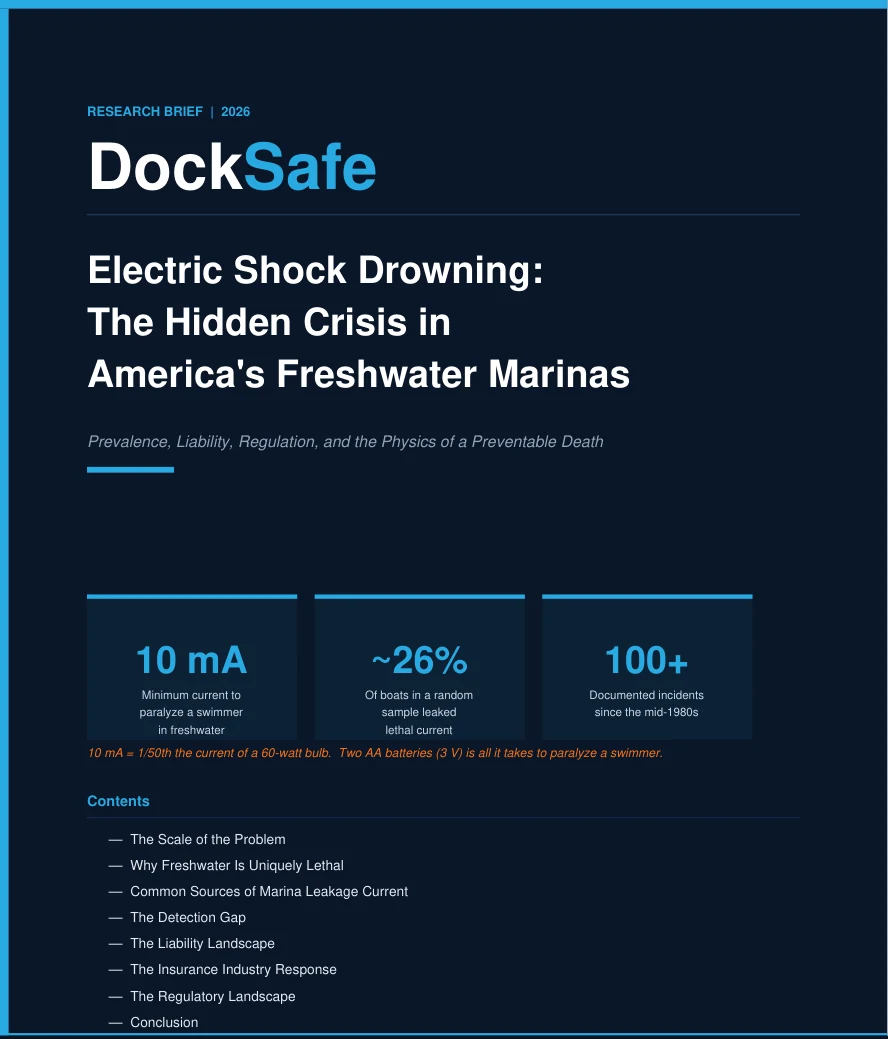
DOCKSAFE RESEARCH BRIEF 2026
The water can reveal what individual tests cannot.
Circuit protection and vessel testing remain important. Direct measurement answers the shared question: what electrical condition exists in the water now?
 Open the full brief →
ONE RANDOM FRESHWATER SURVEY
13of 50
sampled boats
sampled boats
Reported leaking potentially lethal current
WHAT THE SURVEY FOUND
Thirteen boats in a fifty boat sample.
A random survey across three Portland, Oregon freshwater marinas reported potentially lethal current from 13 of 50 sampled boats.
It is not a universal prevalence rate and does not predict the condition at any specific marina.
Source: DockSafe ESD Research Brief 2026, page 3.
WHY FRESHWATER MATTERS
Freshwater changes how current divides between the water and an immersed body.
The brief uses an illustrative model to explain why relatively low voltage differences can matter in freshwater.
ILLUSTRATIVE RESEARCH MODEL
These values explain the cited model. They are not a site specific safety threshold.
DockSafe ESD Research Brief 2026, pages 5 and 6.
DIFFERENT TOOLS. DIFFERENT QUESTIONS.
Circuit protection does not directly measure the shared water.
Protection devices and water measurement serve different purposes. Both matter.
Is this defined electrical path above its threshold?
- One protected AC circuit
- One vessel at the time of testing
- One defined trip or test threshold
What electrical condition exists at this place and time?
- Contributions present in the water
- Location and changing conditions
- History and recurrence
Protection watches a defined path.Direct measurement watches the shared environment.
Summarized from the DockSafe ESD Research Brief 2026, pages 9 through 11 and 14 through 18.
AC AND DC PATHWAYS
The shared water can receive contributions from more than one electrical system.
Shore power remains central. Modern boats and docks also include batteries, chargers, solar equipment, inverters, motors, and bonding systems.
Shore power and AC equipment
Protection devices observe the specific circuits they monitor. They do not directly describe the combined condition in the water.
Batteries, solar, chargers, and bonding paths
DC conditions and corrosion pathways do not pass through the same AC protection boundary.
DockSafe ESD Research Brief 2026, pages 6 through 11.
THE PRACTICAL CONCLUSION
Add visibility to the water without replacing the protections already in place.
DockSafe is designed to complement inspection, circuit protection, vessel testing, and qualified electrical work with direct measurement, history, and an operating record.